- Fact-checked by Josh Miller
- Edited by Diana Westfield
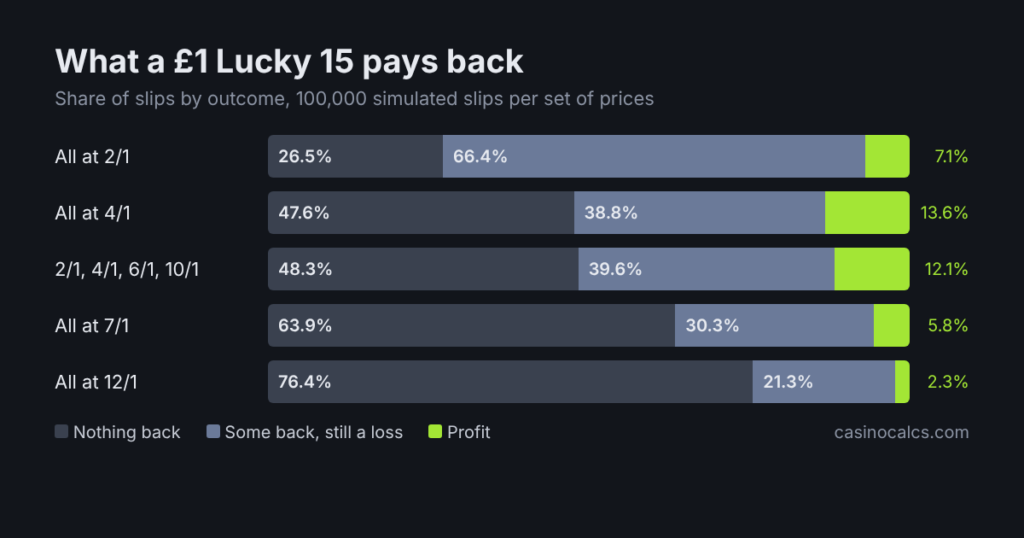
Lucky 15 returns look enormous on the slip and small on most Saturdays, and both of those are true at the same time. We ran 100,000 simulated £1 Lucky 15s (£15 a slip) at five different sets of prices to see what actually comes back. Whatever prices you pick, the bet hands back about £10.65 of every £15 over time. What the prices decide is how you lose the other £4.35: a little every week, or nearly everything most weeks with the odd huge day.
Lucky 15 returns at five sets of prices
Every row is the same bet: four horses, 15 lines, £1 a line. Only the prices change.
| Prices | Nothing back | Some back, still a loss | Profit | Typical slip pays | All four win |
|---|---|---|---|---|---|
| All at 2/1 | 26.5% | 66.4% | 7.1% | £3 | £255 |
| All at 4/1 | 47.6% | 38.8% | 13.6% | £5 | £1,295 |
| 2/1, 4/1, 6/1, 10/1 | 48.3% | 39.6% | 12.1% | £3 | £2,303 |
| All at 7/1 | 63.9% | 30.3% | 5.8% | £0 | £6,560 |
| All at 12/1 | 76.4% | 21.3% | 2.3% | £0 | £38,415 |
“Typical slip” is the middle result, the one you’d see if you lined up all 100,000 slips from worst to best and picked the one in the middle.
Short prices feel safe and still lose
Four 2/1 shots get you something back three slips in four, which is exactly why people like them. But one winner at 2/1 pays £3, and two winners pay £15, which is your stake back and nothing more. You need three of the four to win before you’re in profit, and that happens on about one slip in fourteen. It’s a slow leak rather than a crash.
At 4/1 the picture changes. Two winners now pay £35, so a decent afternoon turns a profit, and you get one roughly every seven slips. If there’s a sweet spot for a Lucky 15 it’s around here, where two out of four is enough.
Big prices: mostly nothing, now and then a lot
Four 12/1 shots is the slip people screenshot, because £38,415 for £15 is a lovely number. The chance of seeing it is about 1 in 55,000. Three slips in four return nothing at all, and a single winner pays £13, which is still £2 down. That one-winner case matters more than the jackpot, because it’s the result you’ll actually get one week in five.
The mixed slip (2/1, 4/1, 6/1, 10/1) behaves a lot like four 4/1 shots, which makes sense: the short one gives you something back often and the long one carries the upside.
Why it always comes back to about 71p in the pound
It looks odd at first, but the sum is simple. Every price in a racing market has the bookmaker’s margin built in. With the margin we assumed (more on that below), a £1 single is worth about 85p on average. A double has the margin twice, so it’s worth about 72p, a treble about 61p and the four-fold about 52p. A Lucky 15 is four singles, six doubles, four trebles and one four-fold, and that mix works out at £10.65 for every £15, or 71p in the pound, whatever the prices are.
So the prices don’t change the average, they change the spread. Putting the same £15 on the same four horses as singles would give you back about 85p in the pound. The extra 14p you give up is what you pay for the chance of a big multiple landing.
What the one-winner bonus is really worth
Lots of bookmakers pay double the odds on the single when only one of your four picks wins. On short prices that hardly matters: at 2/1 the average return only goes from £10.65 to £11.48. On big prices it changes the bet. With four 12/1 shots, one winner now pays £25 instead of £13, so roughly one slip in four makes a profit instead of one in forty-three, and the average climbs to £13.21. That’s still below £15, but it’s 88p in the pound, better than the singles. If your bookmaker offers it, it’s the most valuable thing on the slip. Check the terms first, as some only pay it on certain races or cap the bonus.
How we worked it out
Each horse’s chance of winning came from its price, with an 18% margin taken out, which is in the right area for a 10 to 12 runner UK race at early prices. Big festival handicaps can carry more, and the best prices across several bookmakers less. With a 10% margin the Lucky 15 hands back about 82p in the pound; with 25% it’s about 63p. We then ran 100,000 random sets of results for each row and checked the averages against the exact maths, which agreed to within a few per cent (the rare four-winner slips make simulated averages wobble a bit). The table uses the exact figures. All results are win only, with no non-runners, Rule 4 or dead heats.
To try your own prices, the Lucky 15 calculator settles any slip, including each way and the one-winner bonus, and the CasinoCalcs bet calculator shows how every one of the 15 lines pays.
How does a Lucky 15 compare with a Yankee, a Heinz or a straight acca? What every multiple bet really costs lines them all up at the same margin.
A Lucky 15 is fun because the jackpot is so unlikely. Stake what you’d happily spend on an afternoon out. BeGambleAware.org is free and confidential if it stops being fun.